
Why Every NABH-Aspiring Hospital Needs a Healthcare LMS in 2026
What a healthcare LMS is, how it maps to NABH HRM requirements, and the feature checklist every Indian hospital should evaluate.

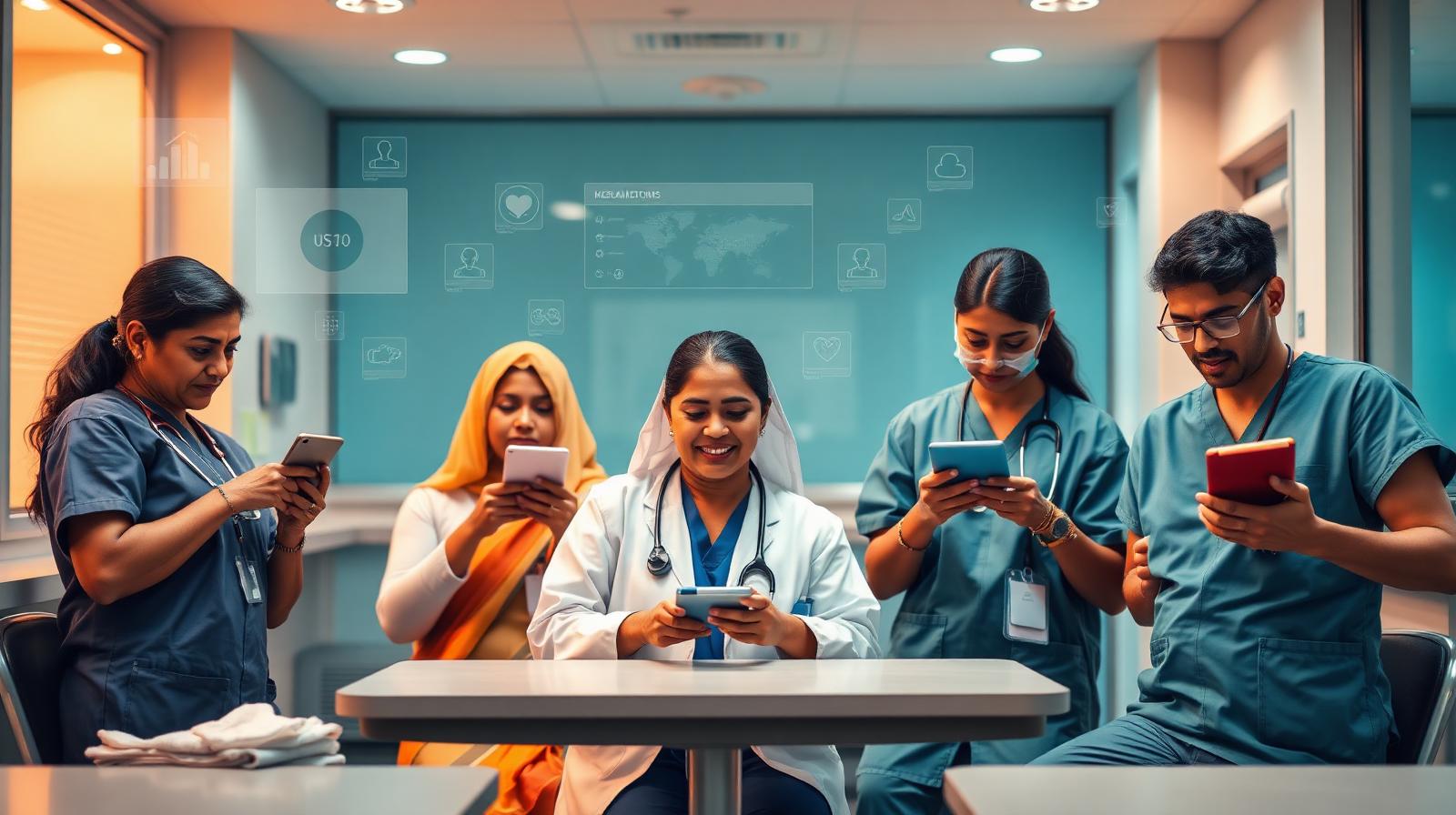
Ask any hospital administrator who has been through a NABH assessment about their biggest stressor, and a disproportionate number will give you the same answer: staff training documentation. Not the training itself — the documentation. Sign-in sheets that cannot be found. Completion records that exist only in a spreadsheet on someone's laptop. Assessors asking whether staff across all three shifts completed the infection control module, and nobody being certain of the answer.
A healthcare Learning Management System (LMS) solves this problem comprehensively — and in 2026, it does much more. The best healthcare LMS platforms have evolved into intelligent training ecosystems that personalise learning paths, embed assessments in video content, proctor high-stakes modules, and produce real-time dashboards that map directly to accreditation requirements.
This article examines what a healthcare LMS is, what it must do for Indian hospitals, how it links to NABH compliance, and what to look for when evaluating platforms.
What Is a Healthcare LMS — and Why Is It Different?
A Learning Management System is a software platform that delivers, manages, and tracks educational programmes for staff. A healthcare LMS is a specialised variant built for the unique demands of clinical and operational environments:
- 24/7 operations with multiple shift patterns requiring asynchronous learning
- Regulatory compliance training (NABH, NABL, JCI, HIPAA equivalents) documented for audits
- Diverse learner roles — from ICU nurses and dialysis technicians to administrative staff and housekeeping
- High-stakes competency requirements where inadequate training has direct patient safety implications
- Multilingual workforce in India's diverse healthcare settings
A general corporate LMS often fails in hospital settings because it is not built for these realities. Tracking whether a dialysis technician completed a module on hypotension management before going on shift is a patient safety issue — not just an HR task.
The NABH Training Compliance Problem — and How an LMS Solves It
NABH Chapter 7 (HRM — Human Resource Management) explicitly requires hospitals to:
- Document all staff training activities with attendance records
- Demonstrate competency assessment — not just attendance — for clinical staff
- Maintain training records accessible for assessor review
- Provide orientation for new hires covering NABH standards, patient rights, fire safety, and infection control
- Conduct annual refresher training for mandatory topics
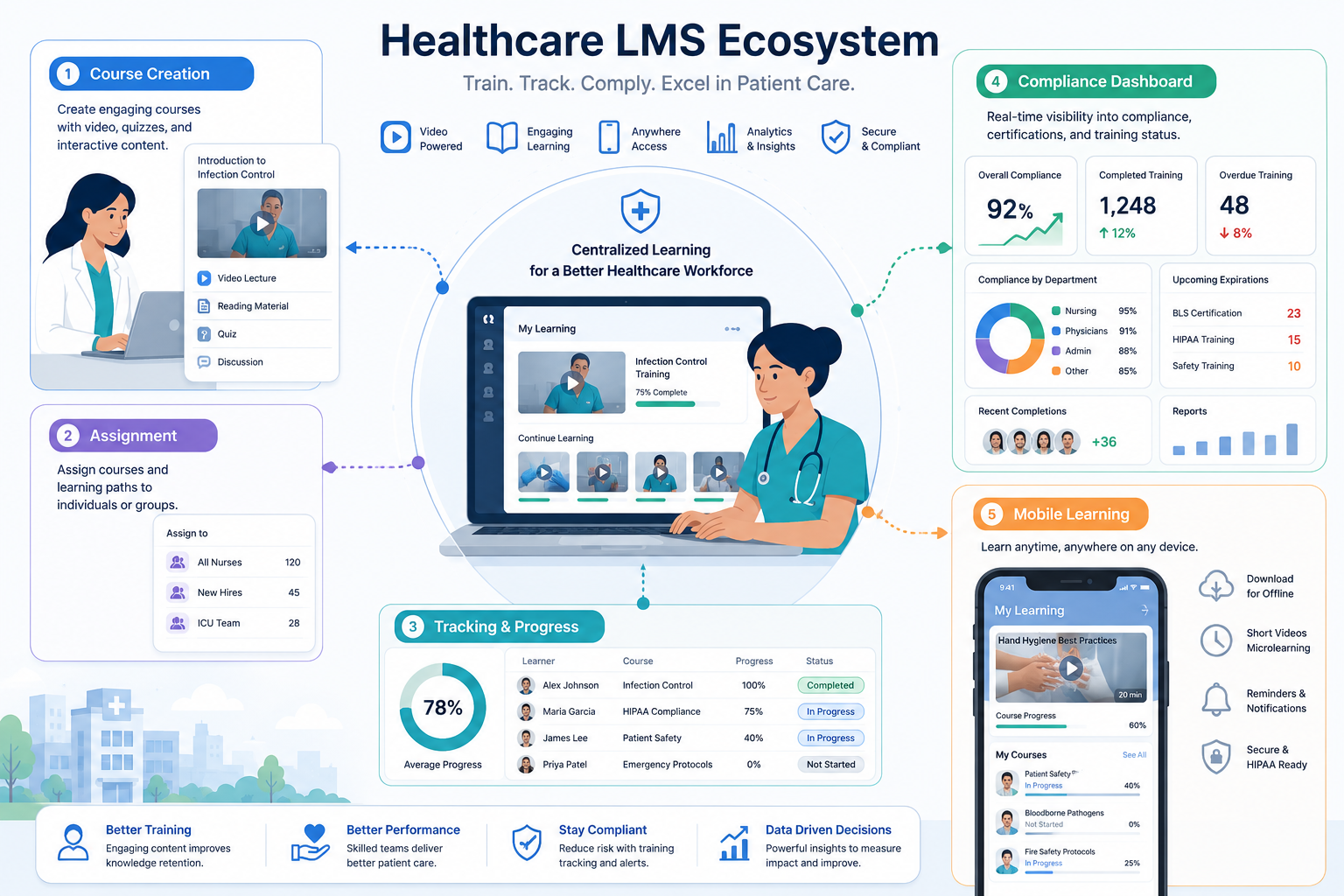
Manual documentation of any of the above across a 100-bed hospital with 200+ staff across multiple shifts is a logistical nightmare. A healthcare LMS automates the entire lifecycle:
- Assign courses to roles, departments, or individuals automatically based on HR system data
- Track completion rates in real time — by individual, department, and shift
- Auto-generate competency certificates linked to employee profiles
- Produce audit-ready reports exportable in NABH-compatible formats
- Set automatic reminders and escalations for overdue training
SurgyLearn generates quiz pop-ups during training videos — preventing passive 'watch without learning' behaviour — and uses camera/mic proctoring for high-stakes assessments, ensuring the right person completes the right module.
Key Features Every Hospital LMS Must Have
1. Auto Content Generation
Clinical training content becomes outdated rapidly. New protocols, updated NABH standards, revised infection control guidelines — hospitals need to update training without rebuilding courses from scratch. AI-powered content generation tools allow administrators to input source documents (SOPs, clinical guidelines, policy updates) and automatically generate structured course content with embedded assessments.
2. Video-Based Microlearning with Embedded Quizzes
Healthcare professionals learn better in short, targeted bursts. Video microlearning — 5–10 minute modules focused on single topics — dramatically improves retention compared to hour-long classroom sessions. Critically, pop-up quizzes during video playback force active engagement and create documented proof of comprehension, not just viewing.
3. Mobile-First Access
Nursing staff check training modules between rounds. Dialysis technicians complete refresher content during machine setup downtime. Housekeeping staff watch infection control videos on their phones. A mobile-first LMS is not a convenience — it is a necessity for shift-based healthcare workers.
4. HR System Integration
When a new nurse joins, the LMS should automatically assign their orientation curriculum without an administrator manually enrolling them. When an employee changes roles, their learning path should update. HR system integration closes this loop, ensuring no one slips through the cracks.
5. Proctored Assessments
For NABH-critical competencies — medication safety, infection control, patient rights — hospitals need to be confident that the right person completed the right assessment under controlled conditions. Camera and microphone proctoring provides this assurance without requiring expensive physical examination infrastructure.
6. Multilingual Support
India's healthcare workforce speaks dozens of languages. An LMS that can deliver content in Hindi, Tamil, Telugu, Marathi, Bengali, and other regional languages dramatically expands the reach and effectiveness of training programmes.
Beyond NABH: The Broader Case for Healthcare LMS
Accreditation compliance is the most immediate driver, but the best-performing hospitals use their LMS for much more:
Onboarding: A structured, digitised onboarding programme reduces time-to-competency for new hires and creates a consistent first impression of the organisation's quality culture.
Quality Improvement Alignment: Learning paths can be tied directly to quality indicator performance. If a ward's hand hygiene compliance drops, the LMS can auto-assign refresher training to that ward's staff.
Leadership Development: Mid-level managers — charge nurses, department heads, operations managers — benefit from structured development programmes delivered through the LMS alongside clinical staff.
Patient Education: Some platforms extend beyond staff to include patient education modules — discharge instructions, disease management guidance, medication adherence content — distributed via the patient's mobile phone.
Evaluating Healthcare LMS Platforms: A Decision Framework
The market offers a wide range of options, from global platforms like Absorb LMS, Cornerstone OnDemand, and Relias to India-specific solutions. Use these criteria to evaluate:
- NABH alignment: Does the platform produce audit-ready reports in formats assessors expect?
- Healthcare content library: Pre-built clinical compliance content, or do you build from scratch?
- Integration: Can it connect with your HIS/HRMS via API?
- Mobile experience: Genuinely mobile-first, or a desktop platform with a mobile wrapper?
- India-specific features: Multilingual support, GST invoicing, local customer support?
- AI capabilities: Content generation, adaptive learning paths, intelligent analytics?
- Proctoring: Can it handle high-stakes assessments with identity verification?
- Pricing model: Per-user per-month, or site licence? What is the total cost at your scale?
SurgyLearn: Purpose-Built for Indian Healthcare
SurgyLearn was designed specifically for the Indian healthcare context, integrating the features above with the operational realities of Indian hospitals and dialysis networks. Its AI-powered content generation, in-video quiz architecture, camera/mic proctoring, HR system integration, and mobile-first design make it uniquely suited for organisations pursuing NABH accreditation or managing geographically dispersed clinical networks.
The platform is already deployed across India's leading dialysis networks — see our DCDC Kidney Care case study for a deep dive — and is expanding to hospital networks across the country.
References
- eLearning Industry: Top Healthcare LMS Platforms 2026
- Oasis LMS: Healthcare LMS Comparison 2026
- Kaltura: Healthcare LMS Key Features
- Absorb LMS for Healthcare
- NABH HRM Standards — Chapter 7
- Surgyy SurgyLearn Product — surgyy.com
Written by
Mohammed Jamil Nasir
Founder — Product & Tech, Surgyy Innovation Labs
12+ years in Product, Design & Tech · PGC AI/ML, IIT-Guwahati · Global MBA, SP Jain · BE-CSE
Mohammed Jamil Nasir leads product and technology at Surgyy Innovation Labs, building AI tools for India's hospitals and healthcare networks. He writes about healthcare AI, accreditation, and clinical operations.
Connect on LinkedInKeep reading

Time Management for Healthcare Professionals: Free AI-Avatar Course on SurgyLearn & YouTube
Our new AI-avatar course on Time Management for Healthcare Professionals is now live on YouTube and SurgyLearn — already deployed at DCDC Kidney Care and Al Salam Hospital, Kuwait. Here's what it covers and how to access it.

NABH 6th Edition: Your Complete 2026 Roadmap to Hospital Accreditation in India
Standards, digital mandates, costs, timelines and a 12-month plan to get your hospital NABH-accredited under the new 6th Edition.