
NABH 6th Edition: Your Complete 2026 Roadmap to Hospital Accreditation in India
Standards, digital mandates, costs, timelines and a 12-month plan to get your hospital NABH-accredited under the new 6th Edition.


If you run a hospital, clinic, or Small Healthcare Organization (SHCO) in India, one acronym has become impossible to ignore in 2026: NABH. The National Accreditation Board for Hospitals & Healthcare Providers has moved from a 'nice-to-have' credential to a near-mandatory requirement — for insurance empanelment, government scheme participation, medical tourism, and, most critically, patient trust.
With the 6th Edition of NABH standards now in force — and a landmark Digital-First mandate reshaping what compliance actually means — there has never been a more important moment to understand the roadmap. This guide walks you through every stage: from the philosophy behind NABH, to the 10 chapters, the new digital requirements, costs, timelines, and actionable tips for a successful assessment.
Why NABH Accreditation Matters More Than Ever
NABH was established in 2006 as a constituent board of the Quality Council of India (QCI). Since then, it has evolved into the gold standard for healthcare quality in India, with its standards recognised and accredited by the International Society for Quality in Health Care (ISQua) — placing it at par with top global accreditation bodies.
The financial argument is equally compelling: NABH Entry Level hospitals receive a 10% extra payout on Pradhan Mantri Jan Arogya Yojana (PMJAY) claims. For high-volume facilities treating economically vulnerable patients, this alone can justify the investment.
"NABH accreditation improves patient safety, lowers infection rates, and boosts overall productivity. The structured framework encourages continuous improvement, but institutional commitment and ongoing oversight are necessary for long-term sustainability." — Frontiers in Health Services, 2025
The NABH 6th Edition: What Has Changed?
Released progressively through 2025, the 6th Edition represents the most significant revision in NABH's history. The headline change: a Digital-First mandate that is no longer optional.
- Digital tracking of at least 75% of patient records is now mandatory
- Strict cybersecurity controls for patient data are part of the standard framework
- Patient-Reported Outcomes (PROMs) are now a quality indicator
- The HOPE Portal is now the centralised platform for all NABH applications and tracking
- Virtual assessments are standard for clinics with up to 5 beds, reducing cost and friction
- The 6th Edition introduced 100+ standards across 651+ objective elements
The Digital Health Standards (NABH-DHS) deserve special mention. A 2026 study in BMC Health Services Research mapped NABH-DHS against global frameworks including HIMSS EMRAM, JCI, and WHO-PAHO IS4H. The study found strong alignment with international best practices — and recommended future revisions incorporate AI governance, advanced cybersecurity, and interoperability metrics.
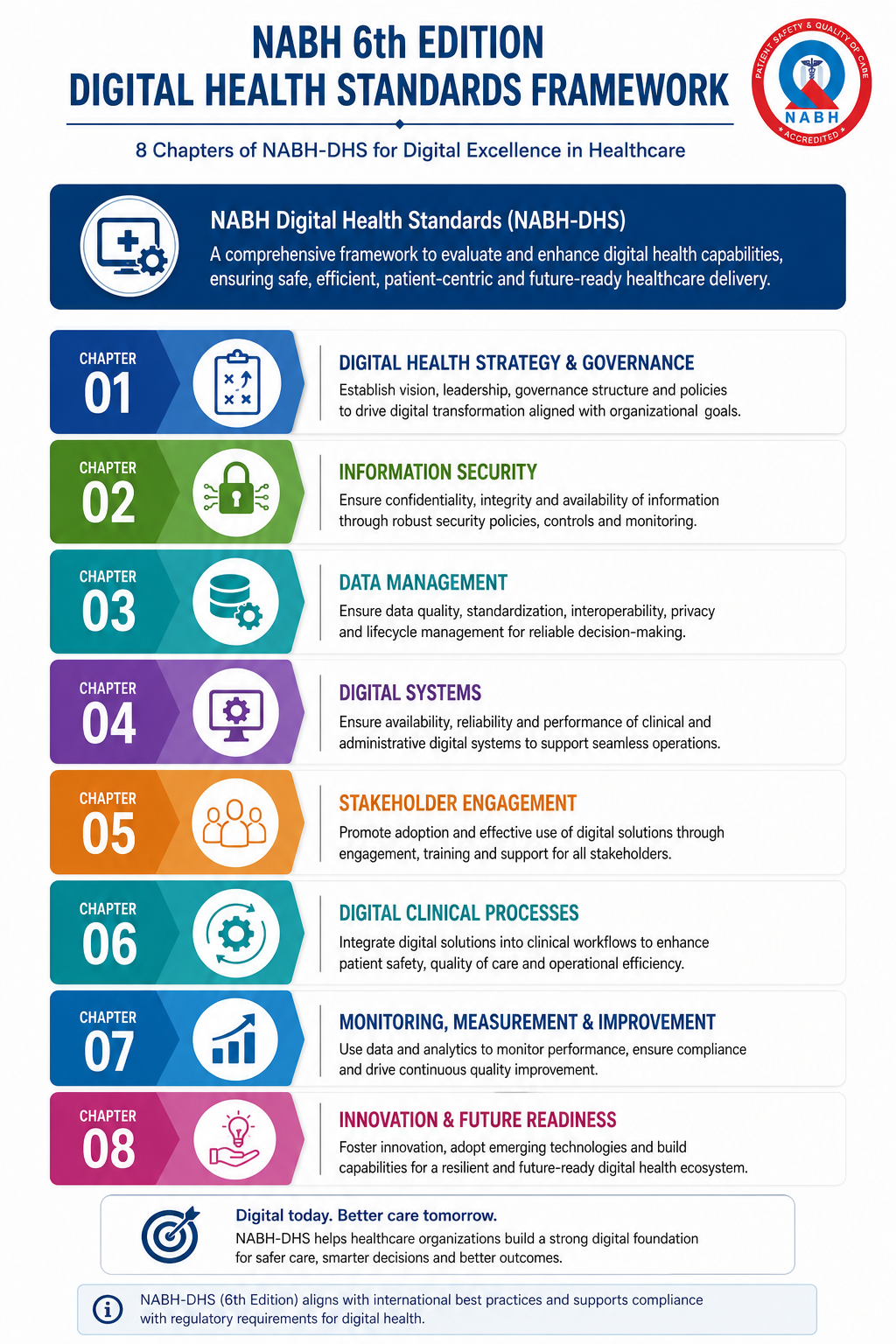
The 10 Chapters of NABH Full Accreditation
NABH evaluates hospitals across 10 chapters. Understanding each is essential for scoping your preparation effort:
- AAC — Access, Assessment & Continuity of Care: OPD queue, patient flow, triage, continuity from admission to discharge.
- COP — Care of Patients: clinical protocols, treatment standards, evidence-based medicine, care planning.
- MOM — Management of Medication: drug safety, formulary management, high-risk and LASA drug protocols.
- PRE — Patient Rights and Education: consent management, grievance redressal, bilingual rights display.
- HIC — Hospital Infection Control: hand hygiene, biomedical waste, antimicrobial stewardship, HAI surveillance.
- CQI — Continuous Quality Improvement: quality indicators, RCA, sentinel event reporting.
- HRM — Human Resource Management: staff credentials, training records, orientation, appraisal.
- FMS — Facility Management and Safety: fire safety, biomedical equipment maintenance, disaster preparedness.
- IMS — Information Management System: EMR/HIS implementation, data confidentiality, interoperability.
- GOP — Governance, Leadership & Direction: hospital policies, ethical framework, governing body oversight.
NABH Accreditation Types: Which One Is Right for You?
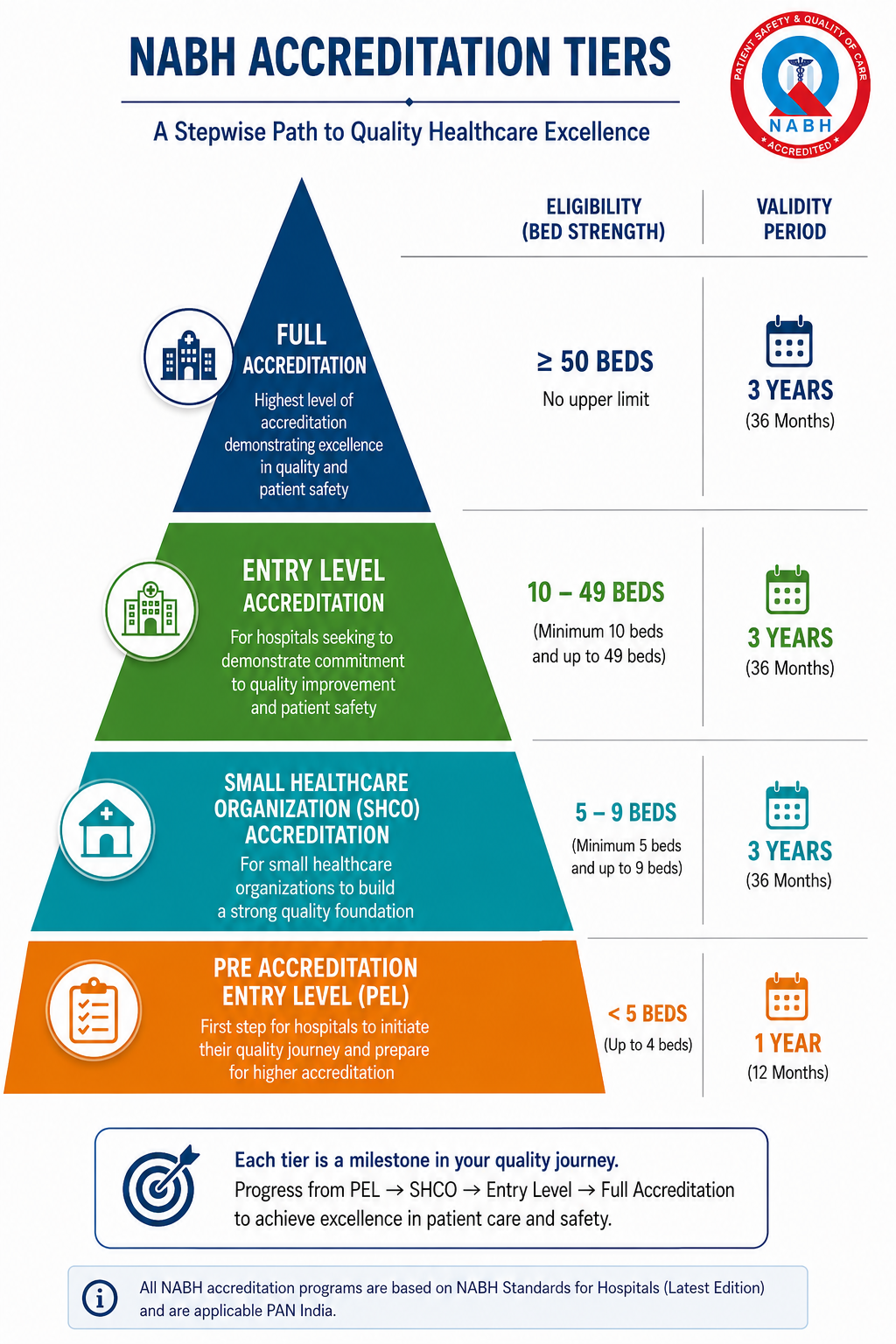
Full Accreditation — For hospitals with 50+ beds. Covers all 10 NABH chapters under the 6th Edition. Valid for 3 years. Required for medical tourism empanelment and major corporate hospital networks. Cost range: ₹3–25 lakhs depending on bed strength.
Entry Level Certification — Covers 5 key chapters. A stepping stone for smaller hospitals. Valid for 2 years. Hospitals can apply via the HOPE Portal and undergo virtual assessment for facilities up to 5 beds. Fees from ₹21,000 + GST for very small setups.
SHCO (Small Healthcare Organizations) — Tailored for clinics and nursing homes under 50 beds. Focuses on core safety — infection control and patient rights — rather than high-level governance.
Pre-Accreditation Entry Level (PEL) — The first step for first-time applicants, intended to help organizations prepare for the Entry Level Certification.
The 12-Month NABH Roadmap
Whether you are a 200-bed district hospital or a 10-bed clinic, a structured timeline prevents last-minute scrambles. Here is a proven 12-month plan:
Month 1–2 — Gap Assessment: Conduct an internal audit against all 10 chapters. Identify critical non-conformities. Appoint a NABH Coordinator and department-level Champions.
Month 3–4 — Policy & Documentation Sprint: Draft and approve all mandatory policies. Build your Document Control System. Ensure 200+ documents are organised and accessible digitally.
Month 5–6 — Staff Training: Conduct all-staff orientation on NABH standards — particularly infection control, patient rights, medication safety, and emergency protocols. This is where a healthcare LMS like SurgyLearn becomes invaluable — auto-generate NABH-specific training modules, assign to departments, and track completion.
Month 7–8 — Mock Assessment: Simulate the actual NABH audit. Walk the floors as an assessor would. Identify and close remaining gaps. Log corrections with evidence.
Month 9–10 — HOPE Portal Application: Submit your application. Upload all required documents, geotagged facility photos, and self-assessment forms.
Month 11–12 — Desktop Review & Assessment: A NABH assessor reviews your documentation online. Schedule and clear the on-site (or virtual) assessment. Close any Non-Conformities within the stipulated timeline.
The Role of Staff Training in NABH Success
HRM Chapter 7 of NABH mandates not just that staff are trained, but that training is documented, tracked, and linked to competency outcomes. This is where most hospitals quietly struggle.
Manual training — printed handouts, classroom sessions, sign-in sheets — creates documentation nightmares. A healthcare LMS solves this by automating the entire training lifecycle: course assignment, progress tracking, assessment, certification, and audit-ready reporting.
- Auto-generate quizzes embedded in training videos
- Proctored assessments for high-stakes compliance modules
- Department-wise completion dashboards for the NABH assessor
- Integration with HR systems so training records stay linked to employee profiles
Our deeper guide on why every NABH-aspiring hospital needs an LMS in 2026 covers the feature checklist in detail.
Common Reasons NABH Assessments Are Deferred
- Incomplete documentation — especially medication policies and consent forms
- Hand hygiene compliance below NABH-specified thresholds
- Absence of a functioning quality committee with documented meeting minutes
- Staff unable to articulate patient rights during the walkthrough
- Missing calibration records for biomedical equipment
- No evidence of root cause analysis for sentinel events
Each of these is preventable with systematic preparation. The HOPE Portal now allows hospitals to track Non-Conformities digitally and submit evidence of closure in real time.
NABH and India's Digital Health Ecosystem
NABH's 6th Edition does not exist in isolation. It is deeply integrated with India's Ayushman Bharat Digital Mission (ABDM), which has already linked 671 million health records digitally and onboarded 410,000 healthcare facilities. NABH-DHS alignment with ABDM means that hospitals investing in digital health now are not just preparing for accreditation — they are positioning themselves for India's long-term health data infrastructure.
The NABH Digital Health Excellence Awards 2025 recognised hospitals using EMR, telemedicine, and digital patient tracking — signalling a clear policy direction: digital adoption is no longer optional in the accreditation landscape.
References
- NABH Official Website — nabh.co
- NABH HOPE Portal — Application & Self-Assessment
- NABH 6th Edition Guide 2026 — adrine.in
- Frontiers in Health Services: NABH Quality Impact Systematic Review, 2025
- BMC Health Services Research: NABH Digital Health Standards, 2026
- Surgyy SurgyLearn for NABH Staff Training — surgyy.com
Written by
Mohammed Jamil Nasir
Founder — Product & Tech, Surgyy Innovation Labs
12+ years in Product, Design & Tech · PGC AI/ML, IIT-Guwahati · Global MBA, SP Jain · BE-CSE
Mohammed Jamil Nasir leads product and technology at Surgyy Innovation Labs, building AI tools for India's hospitals and healthcare networks. He writes about healthcare AI, accreditation, and clinical operations.
Connect on LinkedInKeep reading

Why Hospitals Need More Than a CRM: How SurgyCRM Closes the Gap Between Patient Acquisition and Lifetime Value
SurgyCRM is the only healthcare-native CRM that unifies patient acquisition, clinical journey management, feedback, and field sales into one AI-powered platform — purpose-built for hospitals in India and the GCC.


Time Management for Healthcare Professionals: Free AI-Avatar Course on SurgyLearn & YouTube
Our new AI-avatar course on Time Management for Healthcare Professionals is now live on YouTube and SurgyLearn — already deployed at DCDC Kidney Care and Al Salam Hospital, Kuwait. Here's what it covers and how to access it.