
NABH vs JCI Accreditation: Which Should Your Hospital Pursue in 2026?
Cost, depth, recognition and a decision framework to help Indian hospitals choose between NABH, JCI, or a sequential pathway.


Every year, hospital leadership teams across India face the same strategic question: NABH, JCI, or both? It is not merely a compliance decision — it signals market positioning, patient demographics, insurance relationships, and operational investment priorities.
In 2026, with NABH's 6th Edition bringing it closer to international standards than ever before, and JCI accreditation costs and complexity continuing to deter all but the largest facilities, the answer has become more nuanced. This article provides a rigorous, evidence-based comparison to help hospital leadership make the right choice for their context.
Understanding the Two Frameworks
NABH: India's National Standard
NABH — National Accreditation Board for Hospitals & Healthcare Providers — is a constituent board of the Quality Council of India (QCI), established in 2005. It is the primary accreditation body for hospitals in India, with over 4,200 accredited facilities as of 2026.
NABH standards are accredited by ISQua (International Society for Quality in Health Care) — the apex global body for healthcare accreditation. This means NABH is internationally recognised as a peer of the world's leading hospital accreditation bodies, including JCI. The 6th Edition (2025) added the Digital-First mandate and increased alignment with Patient-Reported Outcomes — see our full NABH 6th Edition roadmap.
JCI: The International Gold Standard
The Joint Commission International is the global arm of The Joint Commission (USA), the world's oldest and largest healthcare accreditation body. JCI accreditation is recognised in over 100 countries and is the de facto standard for hospitals targeting international patients — particularly medical tourism. JCI standards are organised into Patient-Centered and Healthcare Organization functions. The accreditation cycle is 3 years, with mid-cycle focused surveys. The current edition is the 7th Edition.
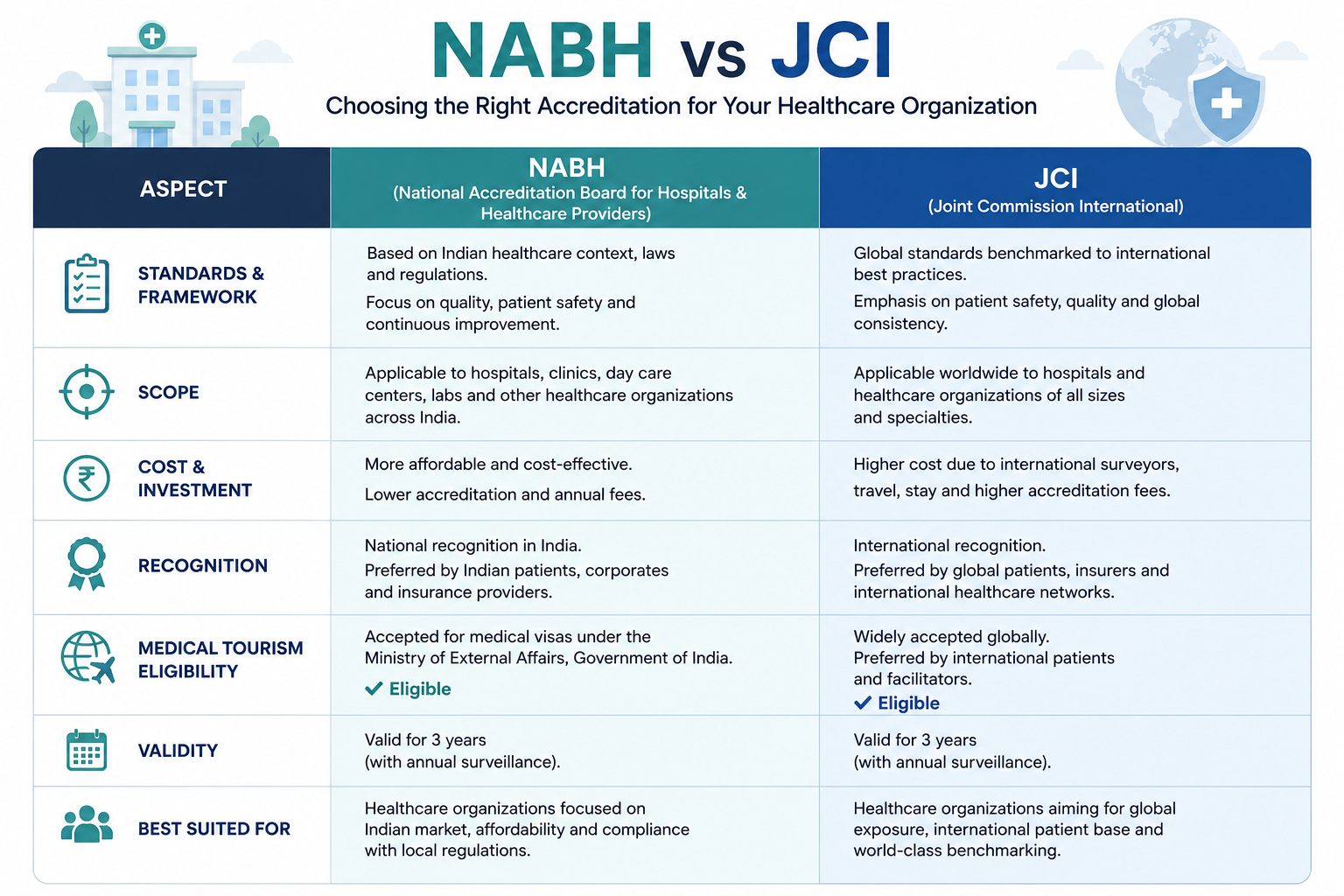
Key Differences: A Detailed Comparison
1. Cost
NABH: ₹3–25 lakhs for Full Accreditation depending on bed strength. Entry Level available from ₹21,000 for small clinics.
JCI: Typically USD 40,000–80,000+ for the full accreditation process, plus substantial internal preparation costs. Total investment can exceed ₹1 crore for large facilities.
2. Standards Depth
NABH: 100 standards, 651 objective elements across 10 chapters. Increasingly aligned with international best practices through ISQua membership.
JCI: Over 1,200 measurable elements of performance across 16 chapters (7th Edition). Greater depth in international patient care, transplant, and academic medical centre management.
3. Assessment Process
NABH: Application via HOPE Portal. Desktop review followed by on-site assessment (or virtual for small facilities). 2–3 year validity depending on tier.
JCI: Initial Application → e-App → Mock Survey (optional) → Initial Survey → Accreditation Decision. 3-year cycle with focused surveys.
4. Market Recognition
NABH: Mandated or preferred for CGHS empanelment, Ayushman Bharat (PMJAY), and most insurance networks. Essential for domestic market credibility.
JCI: Required or strongly preferred for medical tourism packages, international health insurance reimbursement, and partnerships with international referral networks.
5. Staff Training Requirements
NABH: HRM Chapter 7 requires documented training for all staff. LMS-supported training is rapidly becoming standard practice.
JCI: Staff Qualifications and Education (SQE) chapter has detailed requirements for credential verification, privileging, and ongoing professional development. More rigorous for specialist physicians.
Which Hospitals Should Pursue JCI?
JCI accreditation makes strategic sense for a relatively narrow set of Indian hospitals:
- Large corporate hospital networks with a significant international patient revenue stream (Apollo, Fortis, Manipal, Max, Medanta)
- Hospitals located in medical tourism hubs: Delhi-NCR, Mumbai, Chennai, Hyderabad, Bengaluru
- Facilities specialising in high-complexity procedures attracting international referrals: cardiac surgery, organ transplant, orthopaedics, oncology
- Hospitals with international insurance tie-ups requiring JCI for reimbursement eligibility
- Academic medical centres seeking global research and clinical partnerships
The Sequential Strategy: NABH First, JCI Later
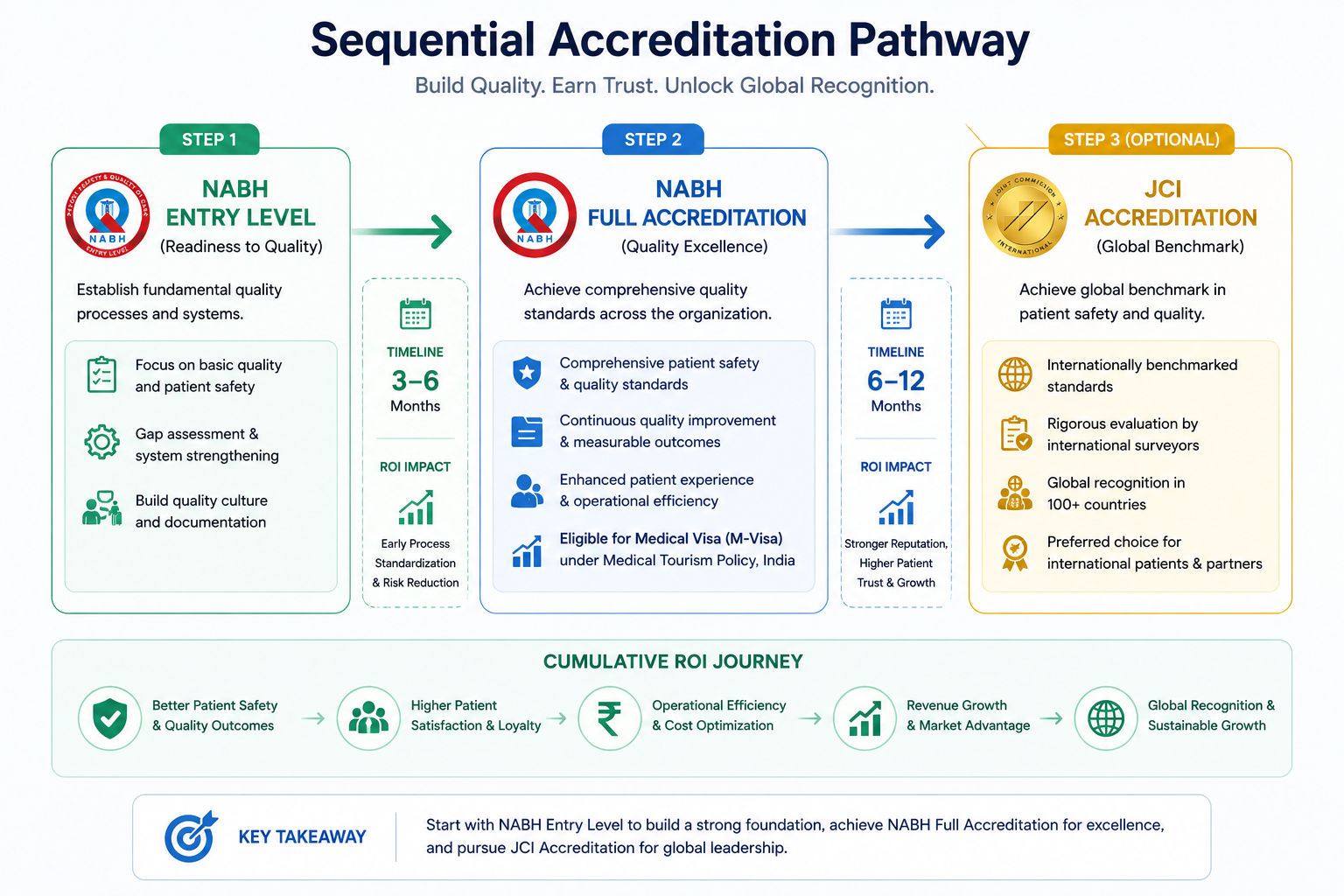
The most pragmatic approach for hospitals with global ambitions is sequential accreditation — NABH first, JCI later. Here's why this works:
1. NABH builds the infrastructure JCI requires. Documentation systems, quality committees, incident reporting, staff training protocols — all mandated by NABH — are also required by JCI. Building them for NABH creates the foundation for JCI without duplication.
2. NABH assessments are practice for JCI. Teams that have experienced NABH assessment processes develop the audit readiness culture that JCI demands.
3. NABH is revenue-generating now. PMJAY empanelment, insurance network participation, and patient trust improvements from NABH accreditation generate measurable ROI that can fund the subsequent JCI investment.
4. The NABH–JCI gap is closing. With NABH's 6th Edition and the new Digital Health Standards, the gap between NABH and JCI is narrower than it has ever been. ISQua accreditation of NABH means international mutual recognition is increasingly real.
The Role of Technology in Dual Accreditation
Whether pursuing NABH, JCI, or both, technology plays a critical enabling role. Key investments that serve both frameworks:
- Healthcare LMS for staff training documentation (NABH HRM / JCI SQE chapters) — see SurgyLearn
- AI clinical documentation (NABH IMS / JCI IPSG patient safety goals) — see SurgyScribe
- Patient feedback systems (NABH PRE / JCI Patient-Centered Standards)
- Quality indicator dashboards (NABH CQI / JCI QPS chapter)
Surgyy's integrated platform — SurgyLearn, SurgyScribe and SurgyFrontdesk — is designed to support exactly this stack, providing a cohesive technology foundation for both accreditation frameworks.
Making the Decision: A Simple Framework
Before committing to an accreditation pathway, answer these four questions:
- What percentage of your patients are international, or what is your target for international patient revenue in 3 years?
- Are you empanelled with PMJAY and major domestic insurance networks? If not, NABH should be the immediate priority.
- Do you have the internal capacity (a dedicated quality team, digital infrastructure, budget) to sustain JCI preparation for 18–24 months?
- Have you already achieved NABH Full Accreditation? If not, start there.
For the vast majority of Indian hospitals — district hospitals, multi-specialty facilities under 500 beds, specialty chains — NABH Full Accreditation is the right and sufficient goal for 2026. JCI is a long-term aspiration for those building international patient programmes.
References
- NABH Official Standards — nabh.co
- JCI Accreditation Standards — jointcommissioninternational.org
- NABH Accreditation Guide 2026 — adrine.in
- NABH vs JCI: Entry Level Certification 2026 — top10doc.in
- BMC Health Services Research: NABH Digital Health Standards — Springer, 2026
- NABH ABH & ABDM Digital Healthcare Transformation 2025 — Nutryah
- Surgyy Integrated Hospital AI Platform — surgyy.com
Written by
Mohammed Jamil Nasir
Founder — Product & Tech, Surgyy Innovation Labs
12+ years in Product, Design & Tech · PGC AI/ML, IIT-Guwahati · Global MBA, SP Jain · BE-CSE
Mohammed Jamil Nasir leads product and technology at Surgyy Innovation Labs, building AI tools for India's hospitals and healthcare networks. He writes about healthcare AI, accreditation, and clinical operations.
Connect on LinkedInKeep reading

NABH 6th Edition: Your Complete 2026 Roadmap to Hospital Accreditation in India
Standards, digital mandates, costs, timelines and a 12-month plan to get your hospital NABH-accredited under the new 6th Edition.

Why Hospitals Need More Than a CRM: How SurgyCRM Closes the Gap Between Patient Acquisition and Lifetime Value
SurgyCRM is the only healthcare-native CRM that unifies patient acquisition, clinical journey management, feedback, and field sales into one AI-powered platform — purpose-built for hospitals in India and the GCC.